


Is Porto Walkable at Night? A Local Guide
By early evening, Porto changes character. The tiled façades take on a softer colour, tables spill onto pavements, and the Douro reflects the lights of Ribeira and Vila Nova de Gaia. So, is Porto walkable at night? Very much so, provided you choose your route with the city’s famous hills, cobbles and quieter streets in mind.
For travellers who enjoy discovering a city at an unhurried pace, Porto rewards an evening on foot. Many of its most memorable places sit close together: elegant Clérigos, the bookshops and cafés around Cedofeita, the grand avenues near Aliados, the historic lanes descending to the river, and the lively restaurants of the lower town. Yet this is not a flat city, and a beautiful walk can quickly become a steep climb. A little planning means you can enjoy the atmosphere rather than watching every uneven paving stone.
Is Porto walkable at night in the central districts?
Yes. The central neighbourhoods are compact, animated and generally comfortable for visitors after dark. Around Aliados, Clérigos, Cedofeita, Galerias de Paris, São Bento and Ribeira, there are usually people dining, walking home, meeting friends or lingering over a late drink. Porto’s evening life is sociable rather than hurried, especially from Thursday to Saturday.
The best approach is to think in levels. The upper city around Clérigos, Carmo, Cedofeita and Aliados is easier for a relaxed dinner-and-drinks stroll. Ribeira, at river level, is particularly lovely later in the evening, but reaching it involves a descent and, depending on where you are staying, a climb back afterwards. If your legs are tired after a day of galleries and viewpoints, take a taxi or rideshare down to the river, then walk along the water at leisure.
From Casa Camélia, the cultural heart of Porto is within easy walking distance. The walk towards Cedofeita and Clérigos feels especially pleasant in the early evening, when independent shops are closing and the city’s restaurants begin to fill. Returning later, the route is straightforward, though the final streets are quieter than the nightlife quarter. That is part of the pleasure of staying near the centre while having a private garden sanctuary to come home to.
The evening walks worth making
Clérigos, Carmo and Cedofeita
This is one of Porto’s most rewarding areas for an evening wander. Begin near the Clérigos Tower, whose silhouette is recognisable from much of the city, then drift towards Rua das Carmelitas and the famous blue-and-white tiles of Igreja do Carmo. The surrounding streets hold wine bars, thoughtful restaurants, small fashion boutiques and galleries.
Continue west towards Cedofeita for a less tourist-led view of the city. This area has a creative, residential energy and plenty of places for supper. It is ideal for couples choosing a restaurant without a rigid plan, or solo travellers who would rather sit at a welcoming bar than commit to a formal meal. The pavements are sometimes narrow and the ground can be irregular, so comfortable shoes make a genuine difference.
Aliados to São Bento
A walk down Avenida dos Aliados is simple, open and well lit. The monumental buildings, illuminated at night, give this part of Porto a grander mood than the tangled medieval lanes below. From here, São Bento Station is close by, and the surrounding streets offer many options for dinner.
This route suits guests arriving back from an afternoon of sightseeing who want an easy introduction to Porto after dark. It also works well if you are travelling with someone who prefers wide pavements and gentler gradients. Keep in mind that the streets leading away from Aliados can become steep quickly, particularly towards Ribeira.
Ribeira and the Douro waterfront
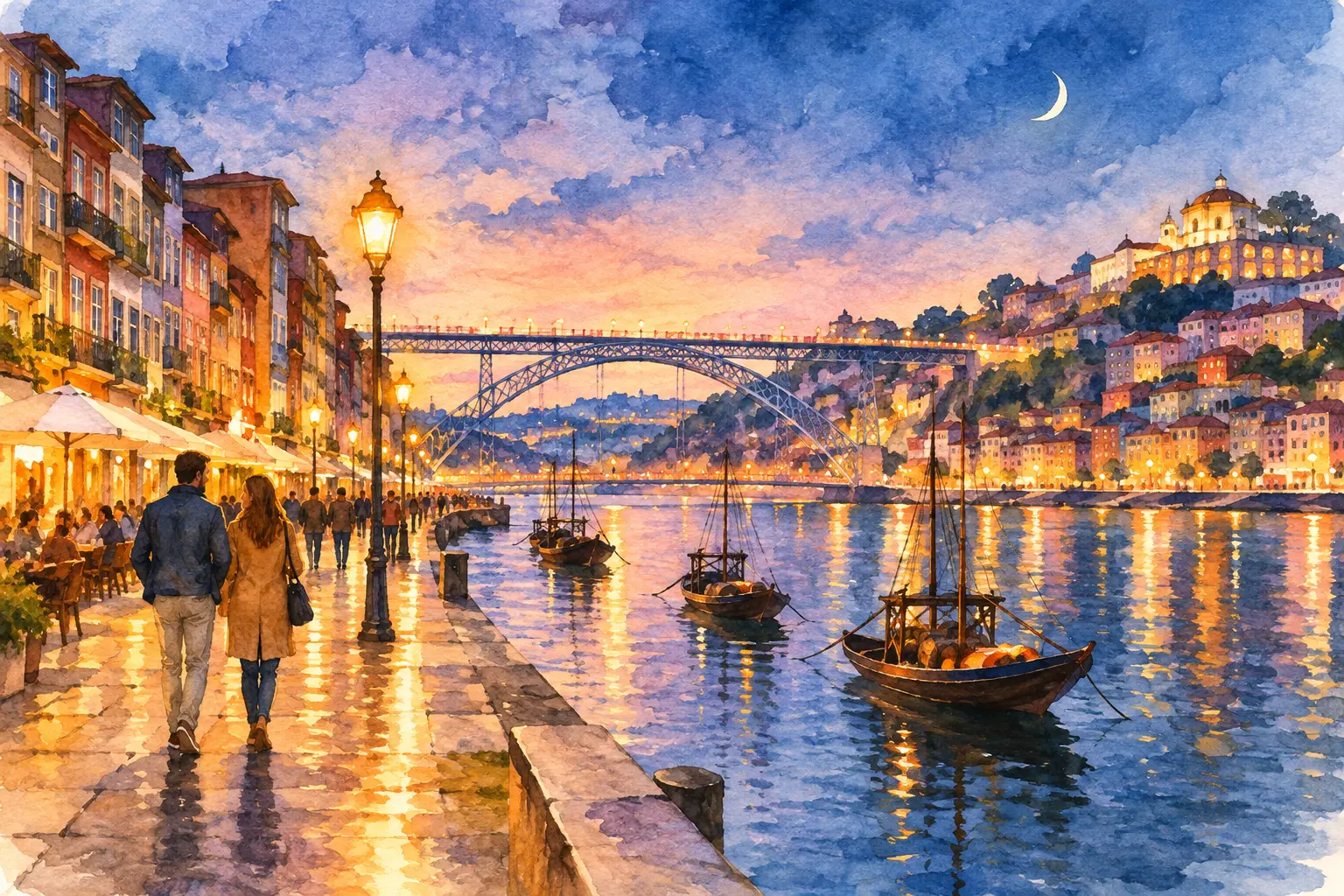
Ribeira is at its most enchanting once the heat of the day has faded. Beneath the Dom Luís I Bridge, the riverfront’s historic houses form a vivid, slightly theatrical backdrop, while across the water the port lodges of Gaia gleam on the hillside. It is a fine place for a slow glass of wine, a late dinner or simply a walk beside the water.
Ribeira is busy in the evening, which can feel reassuring for first-time visitors. It is also more tourist-focused than other parts of the centre, so prices and menus vary considerably. Step one or two streets uphill if you would like a quieter meal with a more local rhythm.
For a longer walk, cross the lower deck of the Dom Luís I Bridge towards Gaia. The views back to Porto are extraordinary after dark. The bridge carries pedestrians as well as road traffic, and the walkway can feel exposed on a windy night. Anyone uneasy with heights may prefer to admire it from the riverbank instead.
Foz and the Atlantic edge
Foz is delightful at sunset and after dinner, with the ocean, promenades and handsome residential streets offering a very different kind of evening. It is not, however, an extension of a central Porto walk. Reaching Foz requires public transport, a taxi or a rideshare, and the journey back should be considered before restaurants close.
Once there, the seafront is largely flat and easy to follow. It is a wonderful choice for a warm evening when you would trade city bustle for salt air and the sound of waves. Just bring an extra layer: Atlantic breezes can be surprisingly cool, even after a sunny day.
What to know about safety after dark
Porto is widely regarded as a welcoming city, and central areas are well used at night. As in any popular European city, sensible awareness is the right companion. Keep phones and wallets secure in crowded places, especially around busy viewpoints, transport hubs and nightlife streets. Choose licensed taxis or established ride-hailing services if you are returning late, and avoid walking alone through unfamiliar, empty side streets simply because a map says it is the shortest route.
The more immediate hazard is often underfoot. Porto’s traditional granite pavements and cobblestones become slippery after rain, while kerbs, steps and changes in level can be hard to see in low light. Shoes with grip are better than delicate soles or high heels. An umbrella is useful from autumn through spring, but it is worth watching where you place your feet rather than walking with your face hidden beneath it.
There is also the question of energy. The journey down to Ribeira is easy; the return can be demanding, particularly after a generous Portuguese dinner. Porto’s funicular, trams and public transport can be helpful at certain times, but services do not run all night and schedules can change. If you are unsure, arrange your return by taxi rather than turning the final uphill stretch into an unwanted expedition.
A few practical choices make nights easier
Start your evening before dark if you want to get your bearings. Porto’s changing light is one of its great pleasures, and a familiar route feels much simpler on the walk back. Download an offline map, make a note of your accommodation address, and check the forecast before leaving. Rain does not diminish Porto’s charm, but it does alter which streets feel comfortable.
For dinner reservations, allow more time than the map suggests. Distances may appear short, yet stairways, hills and photo stops near a miradouro can add twenty minutes without warning. If you have theatre tickets, a river cruise or a table booked on the waterfront, a taxi may be the elegant choice.
Travellers with limited mobility, young children or heavy shopping bags should be selective rather than discouraged. Aliados, Boavista and much of Foz are more forgiving than the steep, tightly paved paths around Sé Cathedral and Ribeira. Porto is walkable, but not uniformly accessible. The city’s ancient contours are part of its beauty and require a little kindness from the itinerary.
When walking is not the best plan
A night walk is less appealing during heavy rain, after a particularly full day, or when you are venturing beyond the familiar central districts. Areas around major stations can be quiet late at night, and the walk between neighbourhoods can feel longer once shops have shut. There is no prize for walking every kilometre of a city break.
Likewise, if your evening is centred on a tasting in Gaia, a concert away from the core, or supper in Foz, make transport part of the occasion. Arriving relaxed leaves more room to notice the details that make Porto unforgettable: a wrought-iron balcony, a lit church façade, the scent of grilled fish from an open doorway, or the river appearing at the end of a narrow street.
Porto invites you to walk with curiosity, not determination. Choose one beautiful route, leave time for a lingering drink or an unexpected view, and let the hills decide when it is time to call a car home.