


Porto Historic District Guide for Curious Walkers
Morning arrives slowly in Porto’s old city. Light catches the blue-and-white tiles of a church façade, café chairs are set out on a steep pavement, and the Douro begins to shine below the rooftops. This Porto historic district guide is for travellers who want more than a hurried list of monuments: it is an invitation to notice the carved doorways, hidden courtyards, old shop signs and changing moods of a World Heritage City.
Porto’s historic centre rewards an unhurried approach. The distances on a map can look small, but the hills are real, the cobbles demand sensible shoes, and a beautiful view may be waiting at the top of a seemingly ordinary lane. Give the old city room in your plans, with time for a long lunch, an occasional pause and the pleasure of taking the less obvious turn.
Where Porto’s historic heart begins
Porto’s historic district is not a neatly contained quarter with a single entrance. It unfolds between the upper city around Sé Cathedral and the riverfront at Ribeira, then stretches west through the streets of Vitória towards Clérigos and the elegant avenues beyond. Each area has its own rhythm, shaped by merchants, clergy, craftspeople, port-wine trade and generations of families who have lived above the shops and workshops.
Begin near São Bento Station, where one of Porto’s most memorable arrivals is written in tile. The grand hall is lined with azulejo panels depicting scenes from Portuguese history and rural life. It can become busy, particularly in the middle of the day, so an early visit offers a calmer chance to admire the scale and fine detail of the work.
From here, walk uphill towards Sé Cathedral. This is one of the city’s oldest quarters, where narrow streets gather around the cathedral precinct and washing may still flutter above stone passageways. The cathedral itself has changed over centuries, carrying Romanesque foundations, Gothic additions and later decorative touches. Its terrace offers a commanding view across the orange roofs towards Vila Nova de Gaia, the river and the bridges.
Let the hills set the pace
Porto is best experienced on foot, but not necessarily all at once. A downhill route from Sé to Ribeira is gentle in spirit if not always underfoot, while the climb back can be demanding after lunch or in summer warmth. Consider using the funicular between the upper town and the river if you would rather save your energy for wandering. The city’s trams and metro are useful companions too, especially when rain makes polished stone and cobbles slippery.
Comfortable footwear is less a practical afterthought than a small act of kindness to yourself. Choose shoes with grip, carry water in warmer months and leave a little space between reservations. Porto often gives its finest moments to travellers who are not rushing towards the next address.
Porto historic district guide: from Sé to Ribeira
The descent from the cathedral towards the Douro is a journey through Porto at its most atmospheric. Look beyond the celebrated viewpoints. Along the way are modest shrines, iron balconies, timeworn façades and small squares where local life continues beside the visitor trail.
Rua das Flores is one of the loveliest routes down from the higher city. Once associated with goldsmiths and prosperous households, it now brings together cafés, independent shops and handsome historic buildings. It can be lively, so it suits a late-morning stroll or an early evening aperitif. Step into the connecting lanes whenever curiosity calls. The quieter streets frequently reveal the more intimate Porto: a tiled entrance, a traditional grocer, a fragment of garden behind a wall.
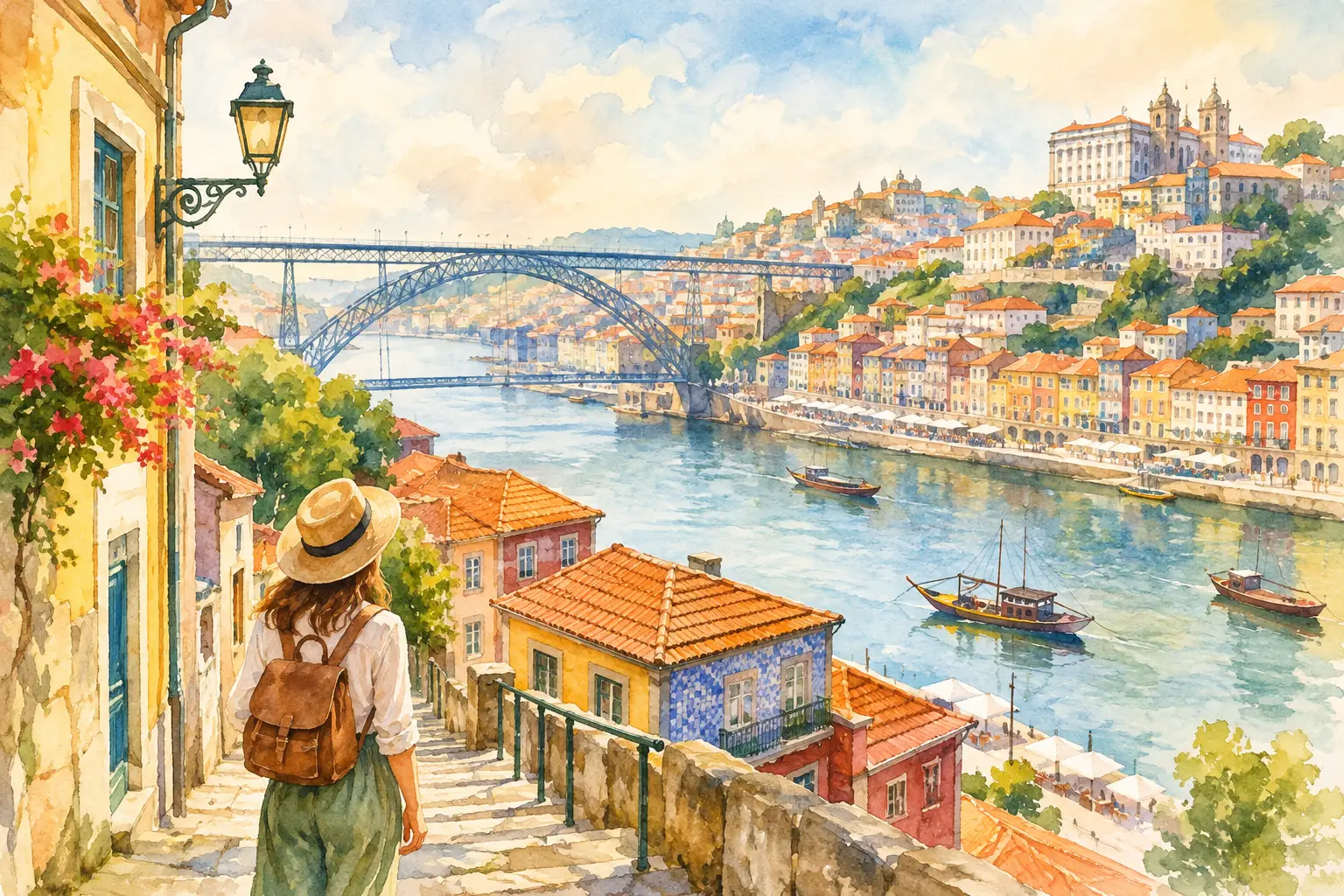
At the river, Ribeira is unmistakable. Tall, narrow houses in faded reds, yellows and blues stand shoulder to shoulder above restaurant terraces, while rabelo boats recall the time when barrels of port travelled downriver from the Douro Valley. It is one of Porto’s most photographed scenes, and for good reason. Yet it is also the place where timing matters most.
Visit Ribeira early for the softest light and a sense of the river before the crowds arrive. Return at dusk to see the Dom Luís I Bridge illuminated against the hillside of Gaia. For dinner, the liveliest riverfront tables are enjoyable for their setting, but the streets just uphill can offer a quieter and more reflective meal. It depends on whether you want the convivial theatre of the quay or a slower evening close to the old city’s residential texture.
Cross the bridge, then look back
Walking across the lower level of the Dom Luís I Bridge is one of Porto’s essential experiences. The span frames the Douro in both directions, with the old city rising behind you and the port lodges of Gaia ahead. Keep close to the pedestrian side and take your time, particularly if you are carrying bags or travelling with children.
Gaia is technically a separate municipality, but it belongs naturally to a historic-centre day. The riverbank provides classic views back to Ribeira, while the hillside lifts you towards broad panoramas. A port tasting can be a pleasing addition, though it is worth choosing a house and format that suits your interest. Some visitors will enjoy a detailed cellar visit; others may prefer a simple glass on a terrace and more time outdoors.
Churches, tiles and the art of looking up
Porto’s churches are woven into daily streetscapes rather than isolated behind grand squares. Igreja do Carmo is famed for its tiled exterior, a sweeping blue-and-white composition that has become an emblem of the city. Nearby, the twin churches of Carmo and Carmelitas appear joined, yet are separated by one of Porto’s famously narrow houses.
Clérigos Tower is another enduring landmark. Its baroque silhouette helps orientate you across much of the centre, and the ascent rewards those comfortable with narrow stairs. Go early or later in the day if you wish to avoid the busiest periods. The view is magnificent, but the surrounding streets are equally compelling, especially around the bookshops, galleries and small cafés of the Vitória area.
Azulejos deserve patient attention. They are not merely decoration. Across Porto, tiles protect façades from weather, celebrate faith and history, and lend ordinary buildings an extraordinary surface. Some panels are dramatic and carefully restored; others are cracked, faded or incomplete. Both tell part of the city’s story.
Find quiet corners between the landmarks
A historic district can feel overrun if you move only between famous sights. Porto becomes more personal when you build in quieter spaces. The gardens around Palácio de Cristal sit west of the oldest core and offer river views among mature trees, peacocks and shaded paths. They are especially welcome after a morning in the steeper streets.
Closer to the centre, look for small squares rather than grand viewpoints. Praça de Carlos Alberto and the lanes around Cedofeita offer a more local change of scene, with independent shops, galleries and restaurants. This part of Porto shows how the city’s historic character continues to evolve. Contemporary design, music and food occupy buildings that still carry the marks of earlier centuries.
For guests staying near the centre, Casa Camélia offers a peaceful return from the city’s energy: an 18th-century manor house with a romantic and vast private garden, where camellias soften the bustle beyond the gate. From here, many of Porto’s cultural landmarks, restaurants and evening addresses remain within walking distance.
A thoughtful way to plan your day
Rather than attempting every landmark, choose one of Porto’s natural routes and let the day take shape around it. A first morning might begin at São Bento and Sé, descend through Rua das Flores and finish at Ribeira. On another day, explore Clérigos, Carmo and the streets of Vitória before walking towards the gardens or continuing to the river at sunset.
Book major museum visits or special dinners in advance during busy months, but resist filling every hour. Porto’s pleasures are often incidental: the sound of glasses being set on a pavement table, the scent of grilled fish from a doorway, or a sudden glimpse of the Douro between buildings. Sundays can be quieter in some shops and neighbourhood businesses, while Mondays may affect museum opening hours, so a little advance checking helps.
The historic centre is beautiful throughout the year. Spring brings mild days and flowering gardens; summer is bright and animated, though it asks for earlier starts; autumn offers warm light and a gentler pace. Winter rain can be frequent, but the city’s cafés, wine bars and tiled interiors become all the more inviting. A waterproof layer is wiser than an umbrella on Porto’s windy slopes.
Leave the historic district with one final walk after dark. The crowds thin, windows glow above the lanes, and the river keeps its quiet course below the bridge. Porto does not ask to be completed. It asks to be returned to, with enough time to find the street you missed the first time.