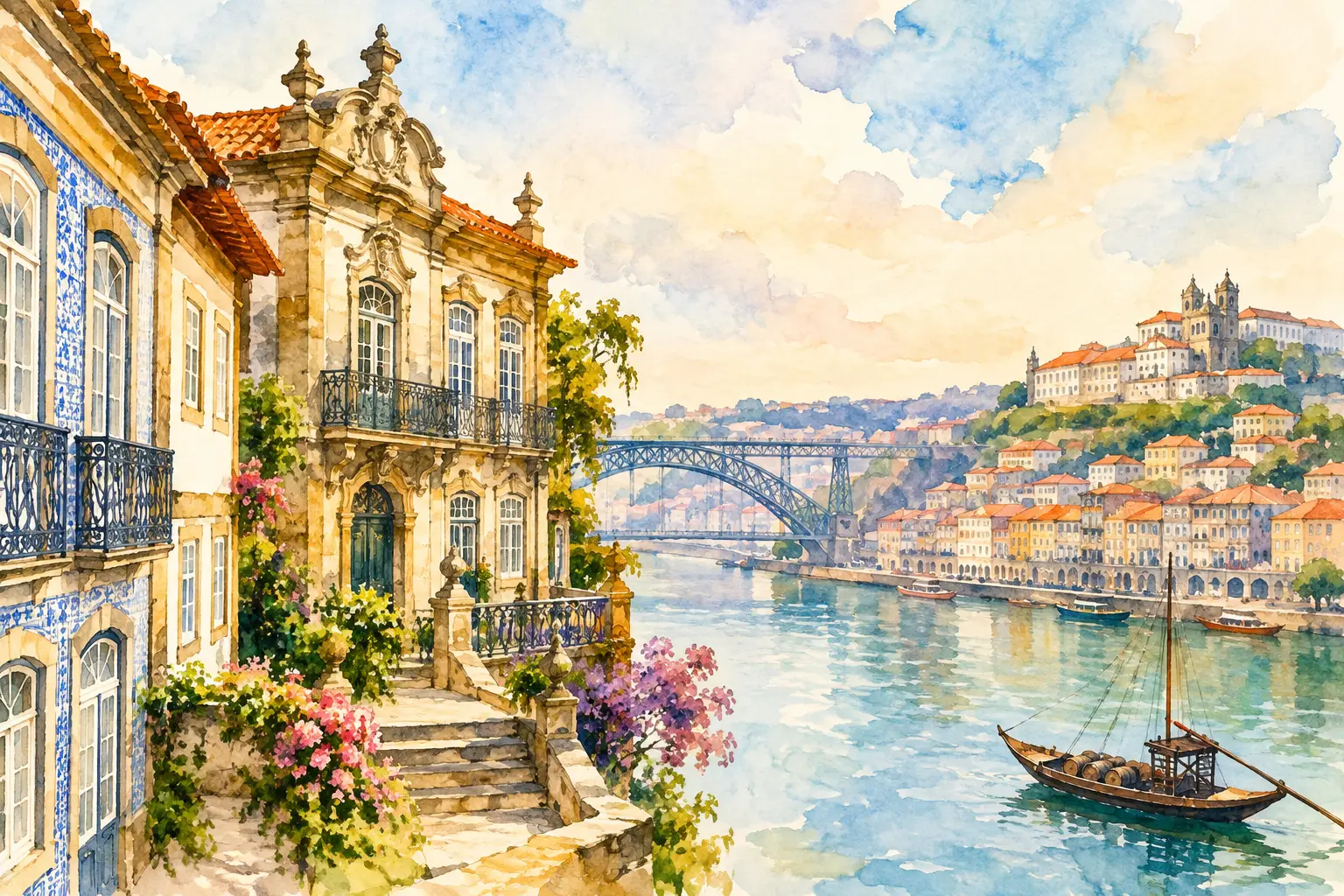



7 Best Historic Houses in Porto to Visit
Porto reveals itself gradually. Beyond the azulejo-covered façades and the busy quayside, its most intimate stories are held inside old houses: former merchants’ homes, noble residences, gardens and rooms arranged as their owners once imagined them. The best historic houses in Porto offer a quieter way to know the city, through painted ceilings, family collections, river views and the particular grace of Portuguese domestic architecture.
These are not all grand palaces in the formal sense. Some are museums, some remain deeply personal in atmosphere, and some are best appreciated for their setting as much as their collections. Allow time to linger. A historic house is rarely a place to rush through.
Casa do Infante: Porto’s medieval heart
Near the Ribeira, Casa do Infante is one of Porto’s oldest and most significant secular buildings. It began life in the 14th century as the royal customs house, standing close to the river at a time when goods, people and ideas moved into the city by water. Excavations have revealed traces of earlier Roman occupation, giving the visit an unusual sense of Porto as a city built in layers.
The building is traditionally associated with the birth of Prince Henry the Navigator in 1394, although its importance reaches beyond that celebrated connection. Its vaulted spaces and archaeological remains make it a compelling stop for anyone wishing to understand the medieval foundations of the World Heritage City.
Casa do Infante suits a morning in Ribeira, before the lanes become busy. Afterwards, continue along the river or climb towards Sé Cathedral, noticing how Porto’s steep streets still follow the rhythms of its historic trading life.
Casa-Museu Guerra Junqueiro: a home of art and ideas
Tucked beside the cathedral, Casa-Museu Guerra Junqueiro occupies an 18th-century house with a handsome Baroque presence. It belonged to the poet, writer and republican politician Guerra Junqueiro, whose collection was later given to the city. The result feels less like a conventional museum and more like an erudite home filled with objects chosen over a lifetime.
Portuguese furniture, religious art, ceramics, metalwork and sculpture unfold from room to room. The pleasure lies in the contrasts: a devotional image beside a finely worked cabinet, an ornate interior opening to an unexpectedly calm courtyard. It is an especially rewarding house for travellers drawn to craftsmanship and the details that give historic interiors their character.
Its location also makes it easy to combine with the cathedral quarter. This is one of Porto’s oldest areas, where washing hangs from balconies and glimpses of the Douro appear between stone buildings.
Casa-Museu Marta Ortigão Sampaio: Belle Époque Porto
For a different vision of the city, seek out Casa-Museu Marta Ortigão Sampaio. This elegant house preserves the collection of Marta Ortigão Sampaio, a woman of considerable cultural curiosity and discernment, who lived here during the 20th century. The atmosphere is refined but never impersonal.
Its exceptional jewellery collection is a particular highlight, including pieces associated with the celebrated Portuguese goldsmith António Maria Ribeiro. Paintings, furniture and decorative arts offer a window onto the tastes of Porto’s cultivated bourgeois families, while the house itself retains the scale and intimacy of a private residence.
The museum sits a little away from the busiest visitor routes, which is part of its appeal. It is a lovely choice for an unhurried afternoon, particularly for those who enjoy design, portraiture and the social history hidden in domestic objects.
Casa São Roque: art, gardens and a changing Porto
Casa São Roque stands in the eastern part of the city, a handsome villa that speaks of Porto’s late 19th-century prosperity. Restored as a contemporary art centre, it makes a fascinating case for how historic architecture can be renewed without losing its soul. The villa’s decorative interiors, staircase and garden setting provide a memorable frame for changing exhibitions.
This is one of the best historic houses in Porto for visitors who want more than period furnishings. Here, old plasterwork and contemporary art are in conversation. The surrounding garden adds to the experience, offering a welcome pause from the dense streets of the centre.
It does require a little more planning than the central museums, but the journey is worthwhile for travellers with an interest in art and adaptive restoration. Porto is not a city preserved under glass. Its most exciting historic places continue to find new uses.
Palácio do Freixo: a riverside Baroque masterpiece
On the eastern bank of the Douro, Palácio do Freixo offers one of Porto’s most graceful architectural encounters. Designed in the 18th century by Nicolau Nasoni, the Italian-born architect whose work helped shape the city’s Baroque identity, the palace is known for its formal proportions, decorative stonework and broad relationship with the river.
The building now forms part of a hotel, so it is not visited in exactly the same manner as a house museum. Yet its exterior, riverside setting and preserved historic spaces make it well worth seeking out, particularly on a walk or cycle along the Douro. There is something deeply Porto about seeing an aristocratic palace set against working waters, boats and the shifting light on the opposite bank.
Go later in the day if possible, when the river softens into gold. The experience is less about ticking off rooms and more about appreciating an architectural landmark in its natural setting.
Museu Romântico: a 19th-century retreat above the river
In the gardens of Quinta da Macieirinha, the Museu Romântico recreates the atmosphere of an affluent 19th-century Porto household. It is associated with King Charles Albert of Sardinia, who spent his final months in exile here in 1849. The rooms are arranged with period furnishings, portraits and decorative objects that evoke the comforts and formalities of the era.
The house may feel quieter and more modest than Porto’s grandest monuments, but that is precisely its charm. Its setting above the Douro, near the leafy gardens of the Romantic Museum area, gives it the feel of a retreat. This is a fine stop for couples or solo travellers looking to slow the pace after visiting the centre.
Combine it with a wander through the nearby gardens and a descent towards the river. Porto’s green spaces often reveal views that the main streets keep hidden.
Casa-Museu Fernando de Castro: a collector’s private world
Casa-Museu Fernando de Castro is perhaps the most theatrical of Porto’s historic interiors. Created by the collector Fernando de Castro in the family home, it is densely filled with carved wood, paintings, sculpture, tiles and religious art. The rooms are richly layered, almost secretive, with little empty space for the eye to rest.
It will not suit every traveller. Those who prefer restrained galleries may find it overwhelming, while lovers of Portuguese decorative art will find it unforgettable. That intensity is its value: this is a house shaped by one person’s passion rather than a neutral museum display.
Visits and opening arrangements can be more limited than at the city’s larger museums, so check current access before setting out. If your dates align, it offers a rare glimpse of private collecting on a grand scale.
How to shape a day around Porto’s historic houses
Rather than attempting every house in one day, choose two or three that reflect your interests. Casa do Infante and Casa-Museu Guerra Junqueiro make a natural pairing in the historic centre. Marta Ortigão Sampaio is ideal for a design-led afternoon, while Casa São Roque and Palácio do Freixo reward those happy to look beyond the most familiar routes.
Wear comfortable shoes. Porto’s beauty is inseparable from its hills, and the walk between houses can be as revealing as the visits themselves. Museum hours, exhibition schedules and access conditions can change, especially for smaller properties, so a little preparation keeps the day pleasantly unhurried.
For travellers staying centrally, a return to a quiet garden at the end of the afternoon feels particularly fitting. At Casa Camélia, an 18th-century manor house with a romantic and vast private garden, the conversation between Porto’s past and present continues in a more personal key. Let the city’s old houses change the way you look at its streets: every carved doorway, tiled hall and shaded courtyard may be the beginning of another story.