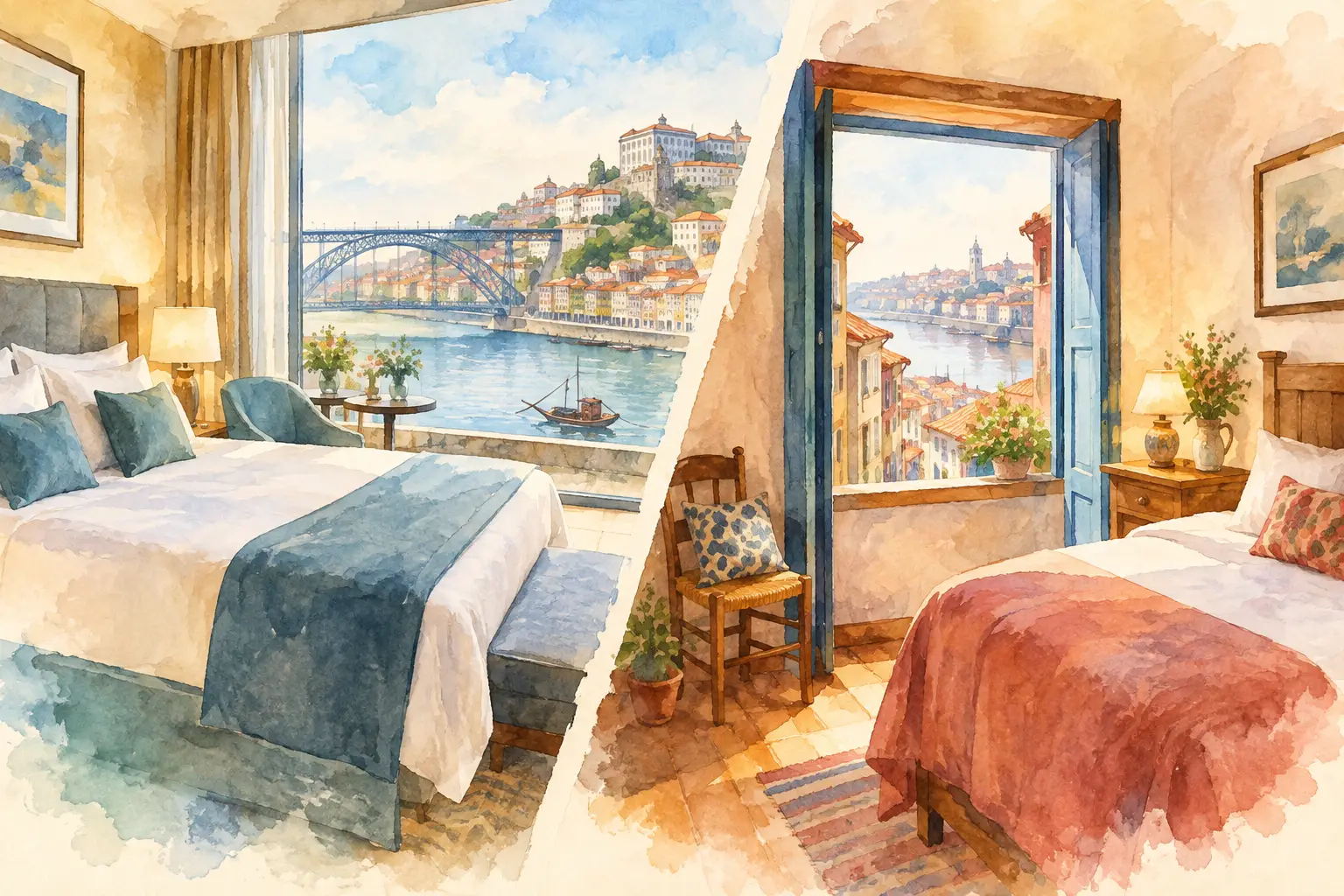



Porto Hotel Versus Guesthouse: Which Feels Right?
Porto reveals itself in layers: the tiled façades caught in morning light, the scent of coffee drifting from a neighbourhood café, the changing colour of the Douro below the hills. When considering a Porto hotel versus guesthouse, the decision is not only about where to sleep. It shapes the rhythm, texture and memories of your time in this World Heritage City.
For some travellers, a larger hotel brings reassuring consistency and a full range of facilities. For others, a small guesthouse offers the feeling of being welcomed into a more personal corner of Porto. Neither is universally better. The right choice depends on whether you value anonymity or familiarity, expansive services or a sense of place, and the kind of holiday you hope to bring home with you.
Porto hotel versus guesthouse: the essential difference
A hotel is generally designed to serve a wide variety of guests at once. This can mean a staffed reception throughout the day and night, room service, a restaurant or bar, lifts, a gym, meeting areas, and sometimes a pool or spa. For travellers arriving late, visiting for work, or wanting every practical facility under one roof, that structure can be genuinely useful.
A guesthouse tends to be more intimate in scale. It may occupy a historic townhouse, villa or restored manor, with a small number of rooms and shared spaces that feel closer to a private residence than a conventional hotel. The focus is often on individual character, thoughtful hosting and the neighbourhood beyond the front door.
The distinction is not always absolute. Porto has boutique properties that pair a guesthouse atmosphere with polished service, beautifully prepared breakfasts and carefully considered interiors. Equally, some city hotels have a distinctive spirit of their own. Rather than relying on the label alone, look at the number of rooms, the building, the communal spaces and how the stay is described.
Choose a hotel when practical ease comes first
A hotel can be the natural choice for a very short stay with a packed itinerary. If you expect to spend most of your time out from early morning until late evening, a straightforward, central room and round-the-clock reception may be all you need. It also suits travellers who enjoy the predictability of familiar standards, especially when arriving in a new city after a long journey.
Larger hotels can work well for families or groups who need several room types, adjoining rooms, or a broad range of facilities. A business traveller may prefer a dedicated work desk, reliable in-house dining and quick check-in. Those travelling in the height of summer might prioritise air conditioning, a rooftop pool or a large lounge where everyone can spread out.
There is a trade-off. The same efficiency that makes a hotel easy can make it feel detached from Porto itself. Public spaces may be busy at breakfast, rooms can follow a repeated design, and a central address does not always place you in a setting that feels particularly local. This matters less if convenience is the only priority, but more if your accommodation is part of the experience.
Why a guesthouse can make Porto feel more personal
Porto rewards unhurried wandering. A guesthouse often suits this mood because it offers a gentler return point between explorations: somewhere to pause after the steep streets of Ribeira, a visit to the bookshops and galleries around Cedofeita, or a late lunch overlooking the river.
In a small property, rooms are less likely to feel interchangeable. Original architectural details may sit beside contemporary Portuguese design, and each space can have its own colour, proportions and point of view. The building itself becomes part of the story, particularly in a city where granite façades, iron balconies and nineteenth-century streetscapes hold such presence.
The scale also changes the quality of service. A team in a small house may have more opportunity to notice the details that make a stay comfortable: whether you prefer a quiet breakfast table, need a recommendation for dinner nearby, or are planning a day in the Douro Valley. This should not be mistaken for formality or intrusion. At its best, it feels attentive, discreet and warm.
A guesthouse is especially appealing for couples, solo travellers and friends who care about atmosphere. It can offer the romance of staying in a home with a history, while still providing the standards expected from a carefully run boutique stay. For design-minded guests, it is often the difference between simply visiting Porto and feeling briefly connected to its creative life.
Consider the spaces beyond your room
The most useful question is not simply, “How large is the room?” It is, “Where will I want to be when I am not in it?” In a large hotel, that might be a bar, pool, lobby or restaurant. In a guesthouse, it may be a library-like sitting room, a sunlit breakfast space, a small terrace or a garden hidden behind the building.
This is particularly valuable in Porto. The city is vibrant, but its hills can make even the most delightful day of sightseeing feel energetic. A peaceful outdoor space gives you a place to read before dinner, enjoy a glass of Portuguese wine, or rest after climbing from the river towards the upper town.
For travellers drawn to historic character, a garden can feel like a rare privilege in the centre. At Casa Camélia, a restored eighteenth-century manor house is set around a romantic and vast private garden, where camellias recall Porto’s affectionate title as the City of Camélias. It offers a quiet contrast to the lively streets only a short walk away.
Location means more than a postcode
Both hotels and guesthouses can be wonderfully located, but different parts of Porto offer different versions of the city. Ribeira is atmospheric and close to the Douro, though it can be lively and busy. Baixa puts many major sights within easy reach. Cedofeita and the surrounding streets offer galleries, independent shops, restaurants and nightlife, with a more residential feeling in places.
When comparing options, consider the walk you will make most often. If evenings by the river are your priority, proximity to the lower city may matter. If you want to browse shops, visit museums and dine in contemporary restaurants, a base closer to the central streets could be better. Porto is compact enough for walking, but its slopes are real, so a location that looks close on a map may require more energy than expected.
A quieter street just beyond the busiest areas can be an excellent compromise. You can step into the city’s life when you wish, then return to calm at night. This is where a small guesthouse often has an advantage: its setting may feel residential and private without sacrificing access to the places visitors come to see.
Breakfast, privacy and the pace of your stay
Breakfast reveals another meaningful difference. A hotel buffet may provide wide choice and speed, which is helpful before an early tour. A smaller property may offer a more relaxed morning, with local produce, fresh pastries and time to plan the day without the atmosphere of a busy dining room.
Privacy also means different things to different people. Some guests prefer the anonymity of a large hotel, where they can come and go unnoticed. Others find privacy in a quieter house with fewer people in shared areas and no crowded lobby. Think about which version helps you rest.
If you are celebrating something special, travelling alone after a busy season, or returning to your room in the afternoon to recharge, the ambience around those moments counts. A beautiful room is lovely, but a stay becomes more memorable when the whole house supports the pace you want.
How to make the right choice for your Porto stay
Begin with the purpose of your visit. For a practical overnight stop, a conference, or a family trip requiring extensive facilities, a hotel may be the clearest answer. For a city break centred on architecture, food, art and time spent walking through Porto’s distinctive neighbourhoods, a characterful guesthouse may offer more of what brought you here.
Read beyond the headline description. Look at photographs of the shared areas, learn whether the building has a story, and check how many rooms are on the property. Consider breakfast, access, luggage needs and whether you would enjoy a garden or terrace. Above all, choose a place that reflects the kind of Porto you hope to encounter.
The finest stays do not compete with the city outside their doors. They give you a peaceful place from which to admire it, then make returning at the end of the day feel like a small pleasure in itself.