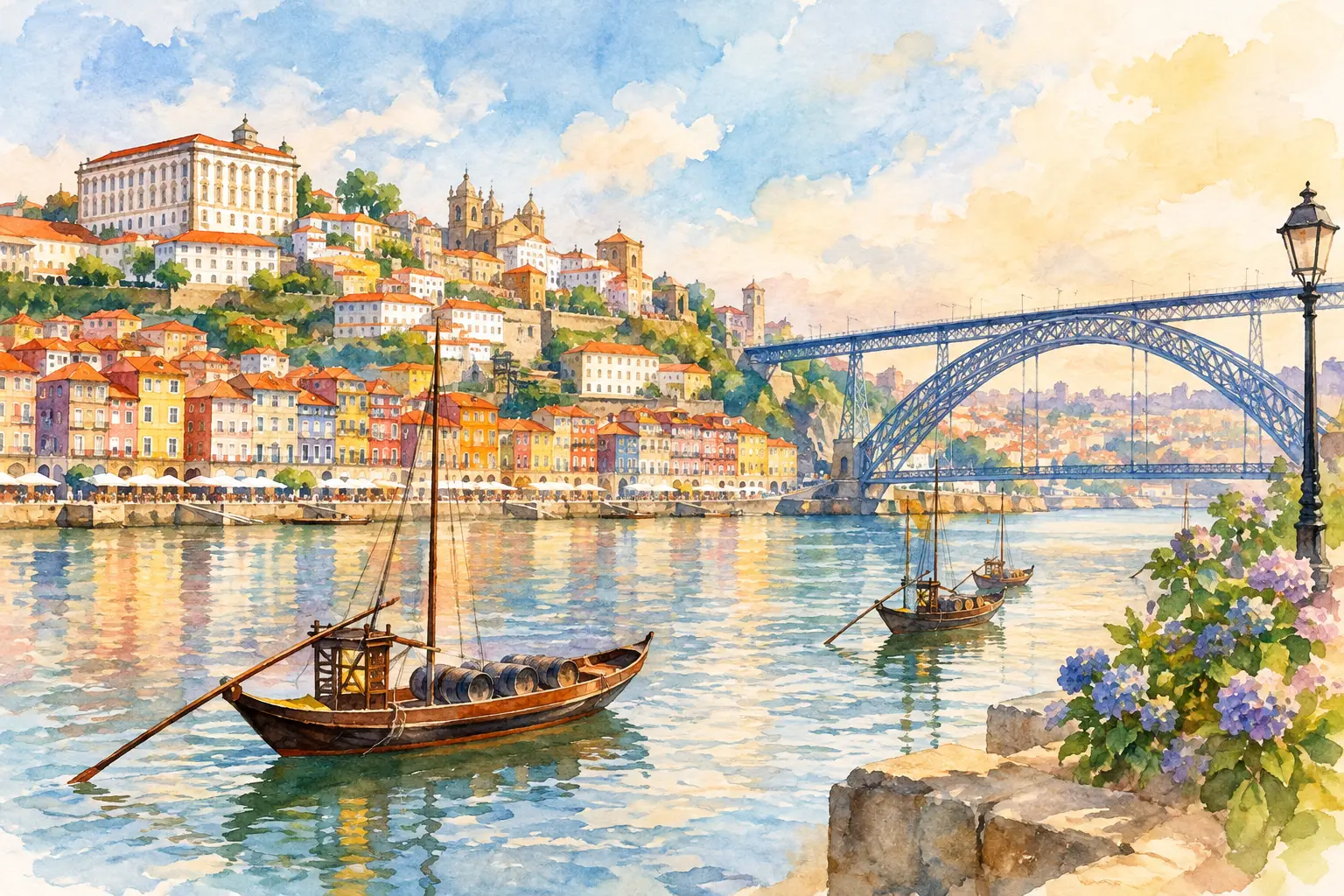



Porto UNESCO Heritage Travel Guide for First Visits
Porto is best understood at walking pace: a tiled façade caught in morning light, the steep lane that suddenly opens onto the Douro, the scent of coffee drifting from an old-fashioned counter. This Porto UNESCO heritage travel guide is for travellers who want to see the city’s celebrated monuments while also feeling the texture of the streets between them.
The UNESCO-listed Historic Centre of Oporto, together with the Luiz I Bridge and the Monastery of Serra do Pilar across the river, is not a museum district to be ticked off before lunch. It is a living city of merchants’ houses, churches, workshops, neighbourhood cafés and viewpoints, shaped by a river that once carried port wine from the Douro Valley to the world.
Why Porto’s World Heritage City feels so distinctive
Porto received UNESCO World Heritage status in 1996 in recognition of an urban landscape with medieval roots and an exceptional relationship to the Douro. Its character lies as much in the whole composition as in any single building: narrow streets descending towards Ribeira, granite churches rising above terracotta roofs, and the great iron arc of the Luiz I Bridge joining Porto to Vila Nova de Gaia.
There is grandeur here, certainly, but it is never overly polished. Laundry may hang above an ancient alley; a handsome townhouse may stand beside a small grocer; worn steps lead towards a baroque façade. This is part of Porto’s beauty. Allow time for detours and resist trying to cover every landmark in one day, especially if cobbled slopes and staircases are not your idea of a leisurely afternoon.
A Porto UNESCO heritage travel guide for two unhurried days
Begin above the rooftops
Start in the upper city, where Porto’s changing centuries are easiest to read. The Sé do Porto, or cathedral, occupies one of the city’s oldest and most commanding sites. Its Romanesque presence is severe from the outside, yet the adjoining cloister brings another mood, with blue-and-white azulejo panels and the quiet enclosure of stone arches.
From here, take time in the streets around the cathedral before descending. Rua das Flores is a pleasing route towards the river, lined with restored façades, small shops and places to pause. It can be busy at midday, so an early start offers a more intimate view of its details: wrought-iron balconies, carved doorways and light falling through the narrow street.
Nearby, São Bento Station deserves attention even if you are not catching a train. Its great entrance hall is covered in narrative tile panels depicting Portuguese history and rural life. Visit in the morning or later in the afternoon if you would like a little more room to look closely. It remains a working station, and that liveliness gives it particular charm.
Continue towards the Torre dos Clérigos, a baroque landmark visible from much of the city. The climb is rewarding for those comfortable with a confined spiral staircase, but it is not essential to the experience. The surrounding streets and gardens provide wonderful views too, and a slower route leaves more energy for the hills still to come.
Follow the city down to the Douro
Porto’s most theatrical descent leads towards Ribeira. Whether you take the streets, steps or funicular, the river appears gradually, framed by old warehouses and tall, slender houses. At the water’s edge, the colour and movement can feel almost stage-like, particularly in late afternoon when boats pass beneath the bridge and the façades across in Gaia catch the sun.
Ribeira is understandably popular. It is a lovely place for a first view of the river, but its busiest terraces are not the only way to enjoy it. Walk a little beyond the main square, sit with a simple drink on a quieter stretch, or cross the lower deck of the Luiz I Bridge towards Gaia. The bridge is a masterpiece of nineteenth-century engineering and one of Porto’s defining experiences. Keep close to the pedestrian side and take care with the metro on the upper deck if you cross there instead.
On the Gaia side, the old port wine lodges recall the river trade that made this landscape prosperous. A tasting can be a worthwhile ritual, especially for travellers curious about the many styles of port. Yet the best choice depends on your interests: some visits are deeply historical, while others are more theatrical and crowded. Book ahead for a smaller, more considered experience in high season.
Make room for the view from Serra do Pilar
The upper deck of the Luiz I Bridge leads towards the Monastery of Serra do Pilar, one of the three elements named in Porto’s UNESCO inscription. The viewpoint near the monastery is among the city’s most memorable, looking over the rooftops of Ribeira, the curve of the Douro and Porto’s layered hillsides.
Come near sunset if you do not mind company, or choose a clear morning for softer light and a calmer atmosphere. The latter can be especially lovely for photographs, but more importantly, it offers a moment to understand Porto’s scale. From above, the city’s famous steepness, density and intimate connection to the river become beautifully clear.
Churches, tiles and the details worth slowing down for
Porto’s religious architecture rewards curiosity. Igreja de São Francisco is known for its extraordinarily gilded interior, a striking contrast to its Gothic exterior. The experience can feel almost overwhelming, which is precisely the point: it speaks of the wealth once tied to trade and devotion.
The Igreja do Carmo is admired for the vast tiled side wall that faces the street, while the neighbouring Carmelite church creates one of Porto’s most photographed architectural pairings. Look beyond the famous surfaces, however. Notice the granite, the carved wood, the modest side streets and the way each building belongs to everyday city life.
Azulejos are one of the great visual languages of Portugal, but they are not merely decoration. They preserve stories, devotional scenes and a sense of light in a city where rain and sun can change the mood within minutes. Some are carefully restored; others are faded and cracked. Both can be moving.
How to experience the historic centre well
Porto’s heritage area is compact on a map but physically demanding. Wear comfortable shoes with a good grip, carry water in warmer months and allow more time than you think you need. Trams, taxis and the funicular can be useful when a long descent or climb would take the pleasure from the day.
Spring and early autumn offer gentle weather and a more relaxed rhythm, although Porto can be enchanting year-round. In winter, bring a waterproof layer and embrace the city’s reflective, misty atmosphere. In summer, begin your sightseeing early, rest during the hottest part of the afternoon, then return to the river as evening settles in.
For meals, move a few streets away from the most obvious viewpoints. Porto’s best moments are often modest ones: a bowl of caldo verde, grilled fish, a glass of Douro wine, or an espresso at the counter among local conversation. Reservations are wise for sought-after restaurants, particularly from Thursday through Saturday.
A stay within walking distance of the historic centre makes all this easier. From Casa Camélia, guests can set out into the city’s cultural heart, then return to the calm of a romantic and vast private garden – a welcome contrast after Porto’s cobbles, viewpoints and evening energy.
Give Porto time beyond its headline sights
The most satisfying heritage visits leave space for the unplanned. Step into a bookshop or small gallery, follow the sound of a street musician, linger at a miradouro with no particular name, or take the riverbank path simply to watch the light change. Porto does not ask to be rushed.
Before you leave, return to one place you loved at a different hour. A familiar square, bridge or tiled church can feel entirely new in rain, in bright morning sun or beneath the first lights of evening. That second look is often where the city becomes personal.